AI-native HR software is payroll, benefits, and HRIS built from the ground up around AI, rather than a traditional HR platform with AI features added on top. In an AI-native platform, chat is the primary interface, the AI can act on your data instead of only reading it, and you can extend the product yourself in plain English. AI-native HR goes beyond payroll and HR administration to become operational software everyone in your company can use to get their jobs done.
The 2025 bolt-on vs the 2026 rebuild
2025 was the year every SaaS company shipped AI features. Most did it for optics, to avoid looking like they were being left behind. The features were bolt-ons: a chatbot in the corner, a summary button, and a sidebar that could read the manual back to you. Nothing changed underneath.
2026 is different. We're now seeing products rebuilt from the ground up with AI at the core instead of stapled to the side. These are the companies that will define how software actually works, and what it does, for the next decade. AI-native HR is what happens when you do that rebuild for payroll, benefits, HRIS, and workflow.
What makes HR software actually AI-native
It runs on chat, not around it
To be AI-native, chat has to be the product, not a feature bolted beside it. Being AI-native is not having a sidebar that quotes documentation. It's a real conversational surface where you do the actual work: check who manages someone, onboard a new hire, change a plan, approve a payroll run, schedule an automatic welcome email for every new employee. If most of your product can't happen in the conversation, you've built a chatbot next to your software, not software you can talk to.
With chat at the center, AI-native gives you something outdated platforms can't: three real front doors instead of one. A real product for the HR/PeopleOps leader who wants to see everything. A real API for the agents that increasingly do the work. And a fully conversational surface for the 95% of your company who should never have to log into HR software again. Staple chat onto a legacy UI and you get exactly one door. Rebuild, and you get all three.
It knows your company, not just HR in general
An AI-native platform has to understand your context. Who your people are, how your policies actually read, how your PTO is configured, which plan each person is on. When an employee asks what their deductible is, the answer comes from their SPD, not a generic explainer. Context isn't something you sprinkle on top of the product. It's what makes the conversation worth having.
You tell it what you want, and it does the thing
AI is moving from generative to instructive. Generative AI writes you a paragraph. Instructive AI does the job. "Add a dependent to my health plan, we just had a baby." "Pay this contractor today." The AI either executes it or pulls the exact piece of UI you need into the conversation and walks you through it.
This closes the oldest gap in HR software: the distance between what an expert knows and what a normal person is trying to get done. A founder doesn't know that paying an urgent contractor invoice means setting up an off-cycle payroll run. They just want the contractor paid. Instructive AI lets them say exactly that, in their own words, and gets it done. The software meets the person instead of making the person learn the software.
The database has to be writable
Traditional software fought to be the system of record for one important thing: the customer, the employee, the ticket. But that thing never sits alone anymore. Employee data connects to the work: the Slack threads, the tickets, the docs, the transcripts. AI-native apps pull all of it together so a model can reason across it to help you find answers.
Read-only AI is a demo. The real bar is a writable system. If the AI can tell you a number but can't change it, approve it, or run it, you're back to the help center. AI-native HR keeps a hard system of record and lets the AI act on it, with clean connectivity to everything around it.
It works where your team already works
Work happens in a lot of places now, and AI-native software assumes as much. Your employees will expect to interact with applications in Slack or Claude. They will want approvals in DMs. Employees shouldn't have to come to your HR tool, or any tool. Your HR tool should show up where they already are.
HR finally gets to build
This is the part that matters most, and the part legacy platforms can't fake.
HR has spent a decade filing tickets and waiting on engineering to build the thing they needed six months ago. AI-native platforms flip that. They're designed from the ground up to let data out and let you build things back in. Missing a process in your HRIS? Build the extension and wire it into your workflow. Want a dashboard that pulls from three systems? Build it, without a roadmap request and a two-quarter wait. Expect smaller core products with far better tools for building the rest yourself.
We built Winslow this way after talking to more than 250 HR teams. The pattern was the same almost every time. They didn't want more features. They wanted to build the handful they were missing, and every platform they'd ever used told them no.
Priced for what you use, not who you hired
There's one more principle, and it's the one people forget because it isn't on the screen. AI-native changes the business model, not just the interface.
Legacy HR and payroll software charges per employee, per month, because a human had to service every seat. When agents run the operation, that math stops making sense. AI-native HR and AI-native payroll should be priced for what you actually use, not levied on your headcount. If a vendor rebuilt the whole stack around AI and still bills you exactly like it's 2015, ask what actually got rebuilt.
The test
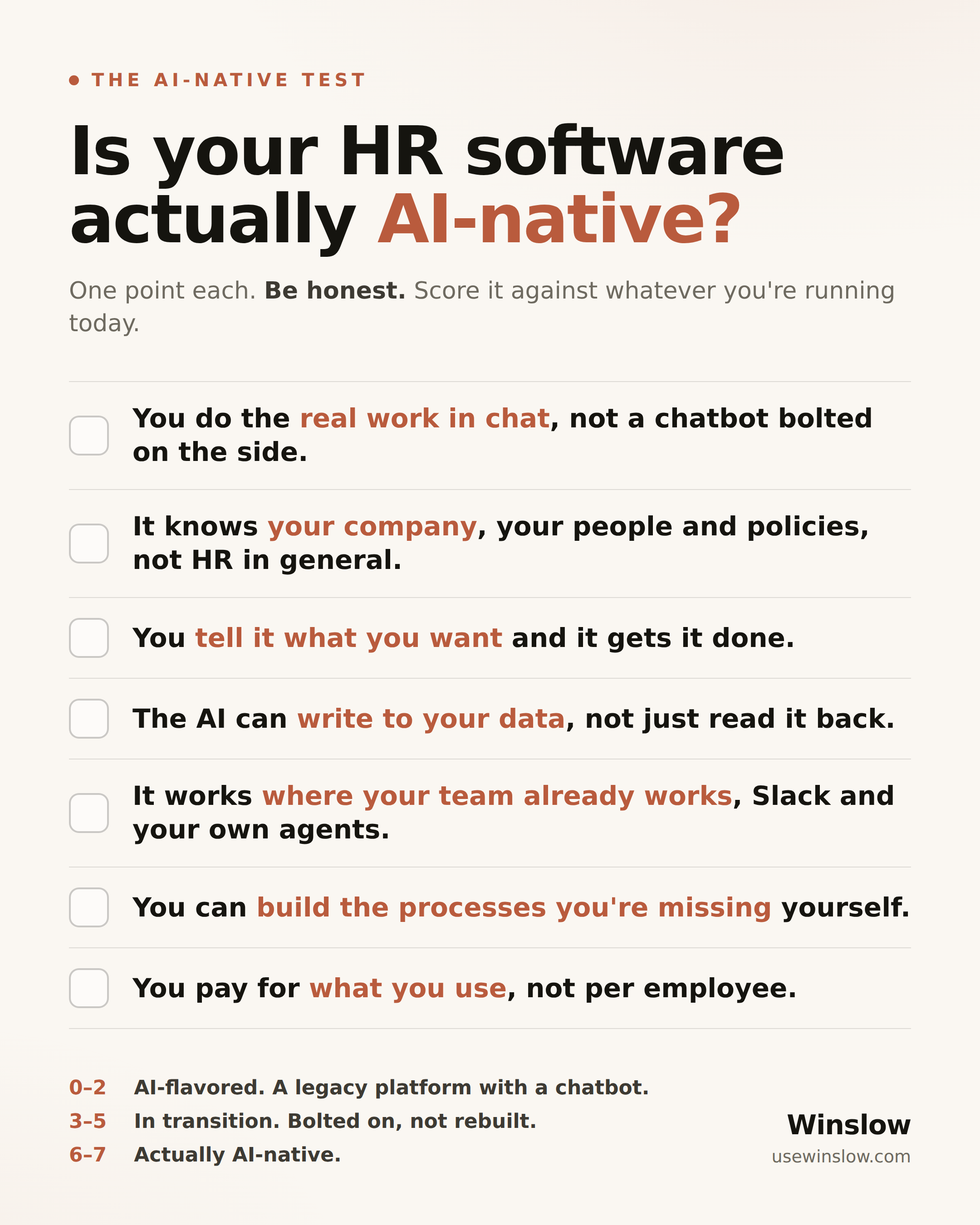
Run these seven questions against whatever HR or payroll software you have open right now:
Can you do the real work inside the conversation?
Does it know your company, not HR in general?
Can you tell it what you want and have it done?
Can the AI write to your data, not just read it?
Does it meet your team where they already work?
Can you build the processes you're missing yourself?
Are you paying for what you use, not for who you hired?
If it fails most of these, it's AI-flavored, not AI-native. And if that bothers you, come talk to us.
Finally, build HR the way you've always wanted.
Follow for more
If this was useful, follow me and Winslow for more on AI-native SaaS, tiny teams, and building companies in an AI world.
Me: linkedin.com/in/nielrobertson
Winslow: linkedin.com/company/usewinslow